Finland "Children's Day" cachets
As Finland was slowly recuperating from the tragic war years of the 2nd War World, actives in Finland followed the example of a multitude of other countries and committed to celebrate the children of the nation. Volunteers from dozen's of charity organizations joined their efforts with some powerful individuals to create the first national Children's Day which then took place in 8.9.1945 in almost 200 villages, cities and towns. A famous Swedish national, Walle Bergström was called from Stockholm to help organize and promote the events and also to link Finnish actives and organizations with Swedish charity organizations. This effort succeeded and Swedish charity institutions provided a healthy injection of much needed supplies with which the Finnish counterparts were able to raise much needed money for the cause.
The main organization behind all this was a Finnish charity called "Koteja Kodittomille Lapsille" (literally translated as "Homes for Homeless Children") established already in 1922 to help find healthy and nurturing homes for the thousands of orphaned children from the earlier decade. This organization was of key importance during the war years of 1939-1945 in both funneling the massive help from the Swedes and organizing pragmatic clothing, food and sheltering help for the warring nation's children. The name no longer reflected the organization's whole operations and another prominent Swede, Margit Levinson (then chairman of Sweden's "Räddä Barnen" charity organization), suggested a new name "Pelastakaa Lapset – Räddä Barnen" (literally translated as Save the Children in both Finnish and Swedish). Under this name the organization took on the responsibilities of the new Children's Day. And under this new name it is still known today.
A major Finnish landmark in Helsinki is the country's oldest amusement park, Linnanmäki, which can trace it's founding in 1950 to the same efforts that gave birth to the then annual Children's Day event. The amusement park is still proud of this heritage today and is trying it's best to funnel at least some proceeds from the amusement park to charity work.
This article tries to present cachet's of these events. As is most often the case with these kinds of special events, the letters and postcards sent are likely philatelic products (ie. bogus; either not actually circulated or circulated with the intent to create a philatelic curiosity). But not all, mind you. The interest here is to collect and present these cachets along with any history associated with them or the event. The first cachets were unofficial and official cachets sanctioned by the postal authorities were present on 1947, 1948 and 1952 only.
Below is a letter with a cachet designed for the first annual event and
which is stamped in the event's first day. The event was supposed to
last an entire week but in most cities and towns around the country it
had to be reduced to a single day of celebrations and fund raising
purely for practical reasons. The cachet was designed for the main event
held in Helsinki. This cover is a philatelic product with a
woefully incorrect rate for a letter. However, it is consistent with a
rate for Printed Matter but there is no way of finding out
whether this was circulated or not. The recipient is a philatelic organization. The cachet itself was a completely
unofficial cachet not sanctioned by Finnish postal authorities. In fact,
the first officially sanctioned Children's Day cachet was put out years later – for the 1948 event of Children's Day.

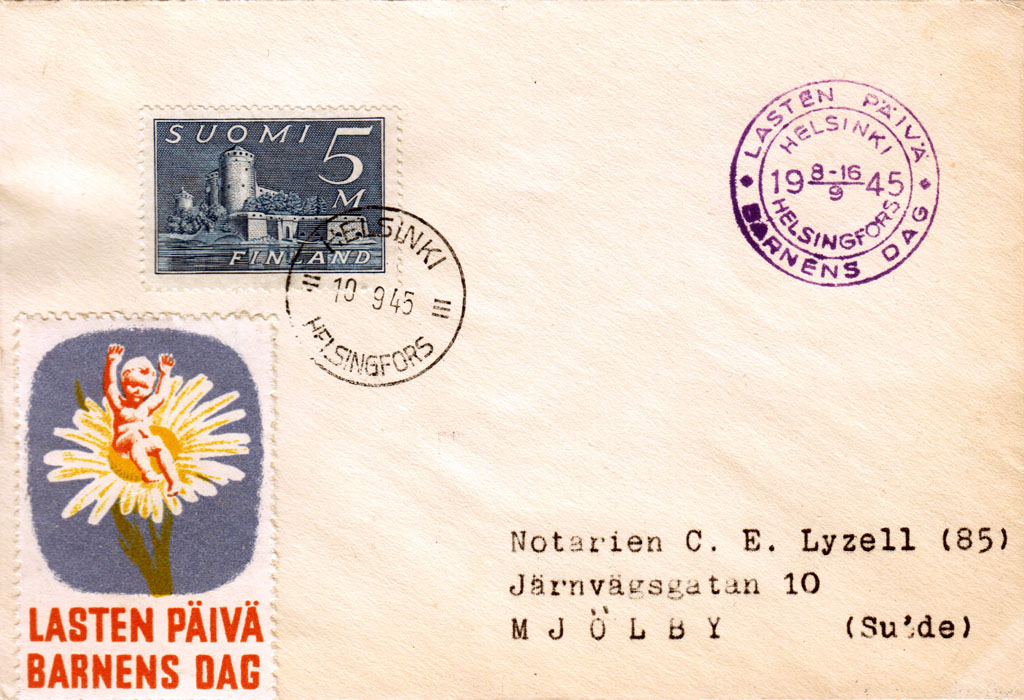
Below a letter dated 10.9.1945 to Sweden representing the 3rd day of the event.
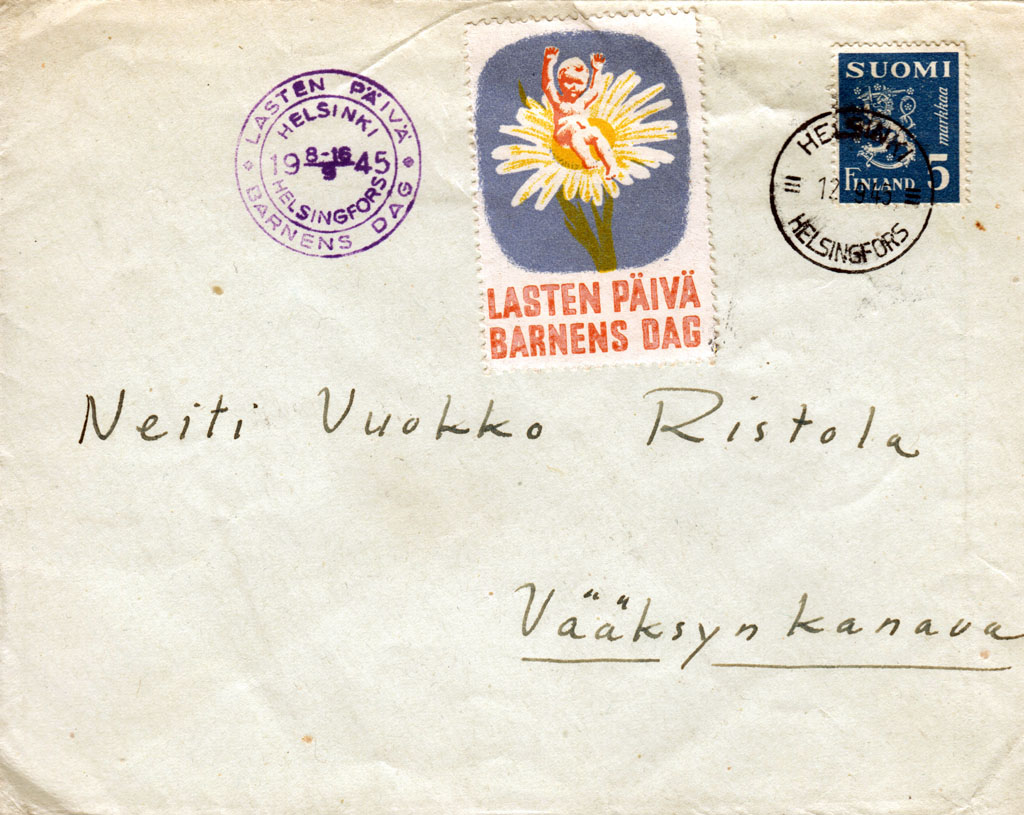
Below a letter dated 12.9.1945. So it was sent on the 5th day of the event.
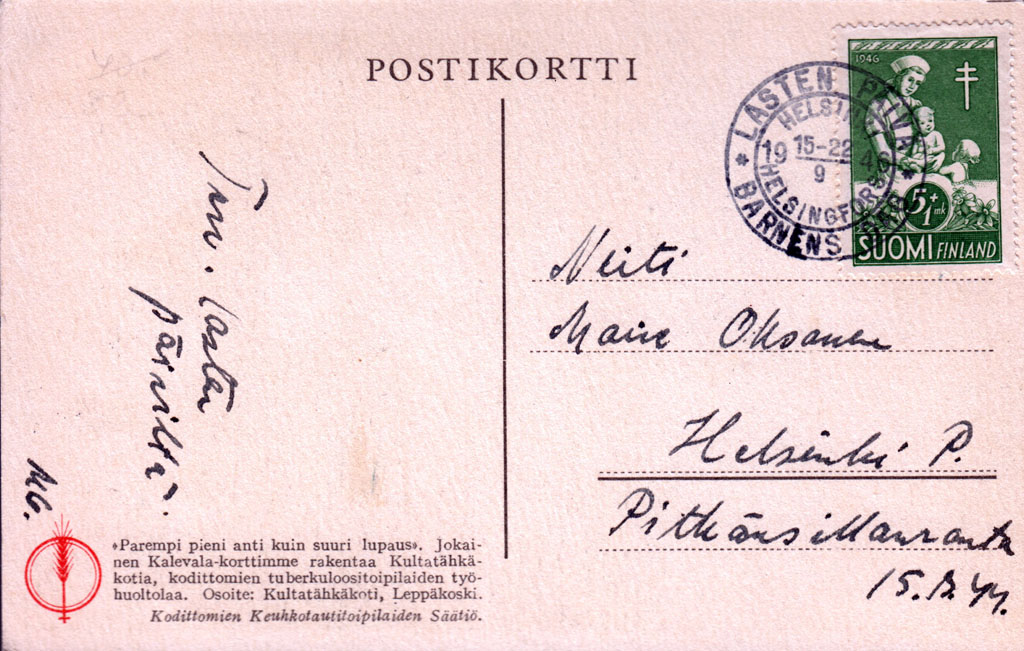
Below is a postcard of the 1946 event. Again, the cachet was not officially sanctioned by Finnish postal services. There is no evidence that the postcard was actually circulated or whether it was just cancelled for philatelic purposes.
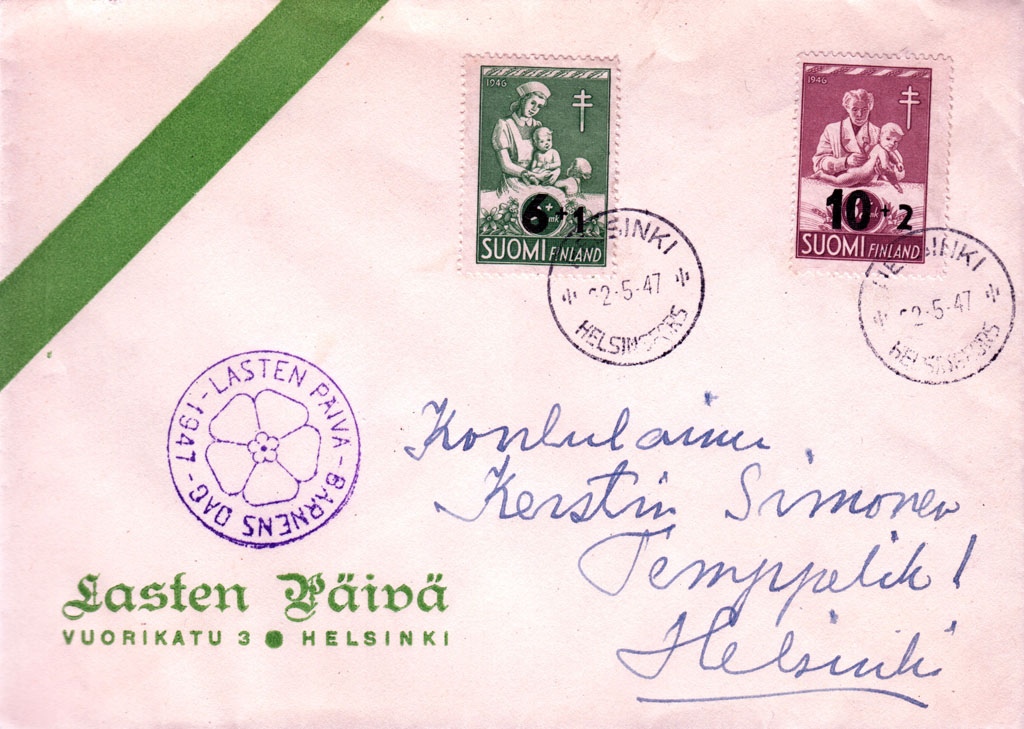
Below is a letter with a cachet from the 1947 event. I've not been able
to figure out the extent of the event that year (ie. how many days the event lasted). Again, this might
be a philatelic product as the rate is consistent with a postcard and
not with a letter. However, in some circumstances, letters containing a
single postcard would get circulated with a postcard rate. No way to
know for certain as the cover has no other postmarks.

Below is a letter dated 22.5.1947 from the 1947 event. This was an official envelope of the event.
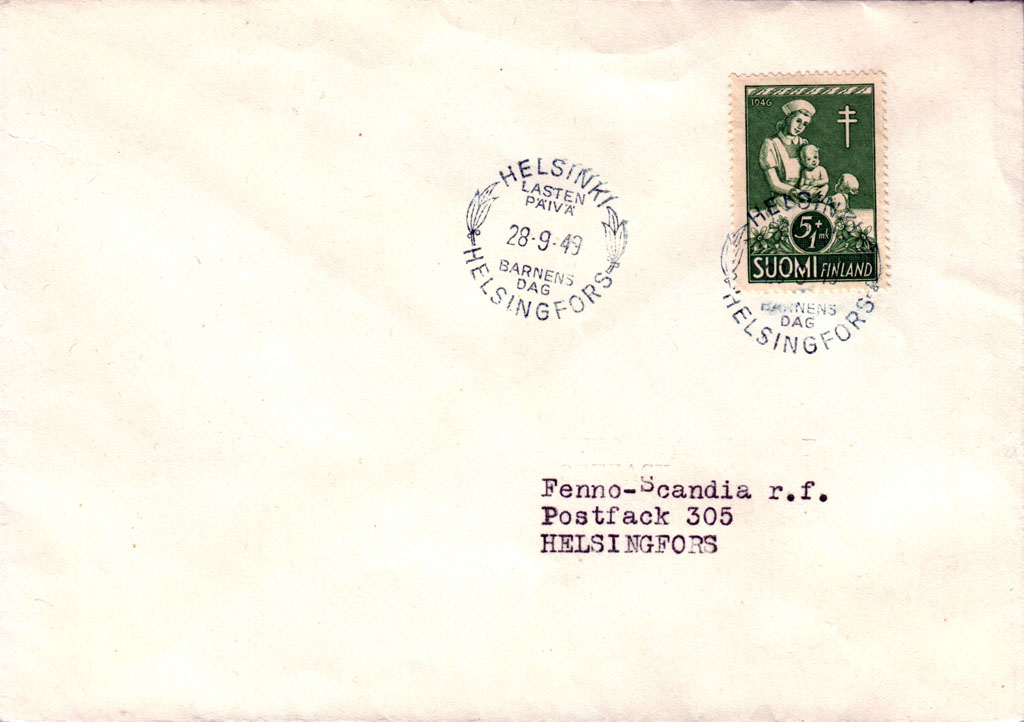
Below is a letter from the 1949 event dated 28.9.1949. It has an arrival stamping Helsinki 1.10.1949 on the reverse side so it was officially circulated even though the cover is clearly a philatelic product. At this time the cachet was officially sanctioned by the Finnish postal services so cancellation with the cachet was accepted.