Polar philately
Arctic
Watkins Mountains Expedition Phase II - 1971
This expedition was an Anglo-Danish mountain survey expedition of the Watkins Mountains - which is a group of nunataks in the hinterland of the perilous and hard-to-access Blosseville coast in Greenland's easter side. The expedition was an extension of a previous expedition led by Alastair Allan two years earlier. The earlier expedition met severe difficulties with extremely difficult weather conditions and the expedition members actually made it out alive by miraculous luck after traversing severely weakened and wet in white-out conditions blindly for two weeks towards their designated rendezvous point with their support boat 'Entalik'. The expedition's aim was to climb the Ejnar Mikkelsens Fjeld (3261 m) but they didn't make it having encountered some of the roughest weather conditions in a century. A Scottish team led by Andrew Ross ascented the mountain succesfully in 1970.
Alastair Allan tried again in 1971 and this time with a crew of four other men: British geologist David Matthews, a Dane deputy leader Vagn Bjerne Christensen, a Dane radio-operator Torben Eriksen and a Dane physicist Steen Morup. The expedition departed from England on 10.7.1971 via a charter plane. The crew went from Iceland's Reykjavik airport to Kulusuk Island and further to Ammassalik Island. From Ammassalik they embarked a ice-reinforced motor cutter (aptly named Ejnar Mikkelsen) which took them to a remote Danish weather station in Nordre Aputiteq Island. At the time the weather station had a crew of seven men and the arrival of the expedition was the first ship they welcomed in about a year! The station was operational between 1949 and 1979. The expedition crew spent three days in the motor cutter and prepared a batch of 3000 postcards signed with their names on the them. This effort was part of the funding of the expedition. The letters were then off-loaded and processed in the weather station's mail room. Upon returning from the expedition the postcards received an additional red inked three-line stamping (inside the blue expedition cachet) indicating that the expedition had succesfully climbed the highest mountain peak in the Arctic. Upon their return the cards were flown to England and Denmark from the Ammassalik Island to their respective recipients. However, for unknown reasons a few hundred cards sent to Denmark were left without the red inked extra stamping. Also of note is that some cards have a 60+10 øre postage stamp but most have a 60 øre one. This was due to the fact that there just weren't enough of the surcharged stamps to cover the whole lot. The mail stamp was also incorrectly set-up and the "Aputiteq" cancellation has a "." between the number indicating the year 1971.
The mission focused on scientific observations (geology, glaciology and meteorology) but also on ascenting Gunnbjørn Fjeld nunatak. The nunatak is the highest mountain peak of Greenland north of the Arctic Circle with a height reaching to 3733 metres above sea level. The expedition became the second team to ascent the highest peak the first being a British-Danish expedition in 1935. The expedition met almost all of their goals and returned at the end of August.
The below postcard is one of the 3000 cards signed by the expedition members. It is lacking the red-inked stamping that was to be put inside the expedition's blue cachet.
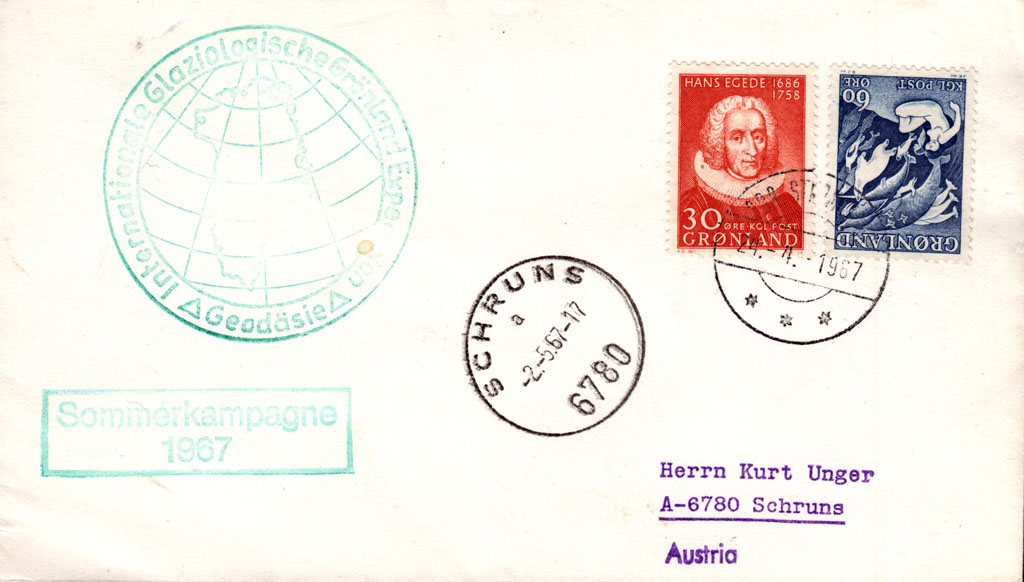
Internationale Glaziologische Grönland Expedition 1967
Antarctic
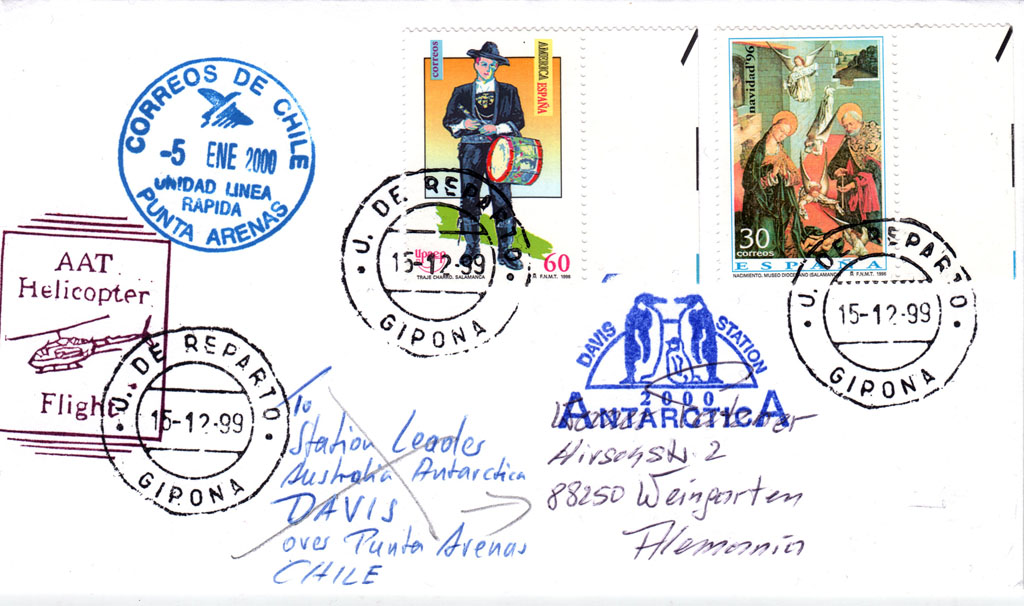
Davis Station